




Home›Blog›Why Does an AI Accent Detector Give Different Results?
Pronunciation SkillsWhy Does an AI Accent Detector Give Different Results?
Contents
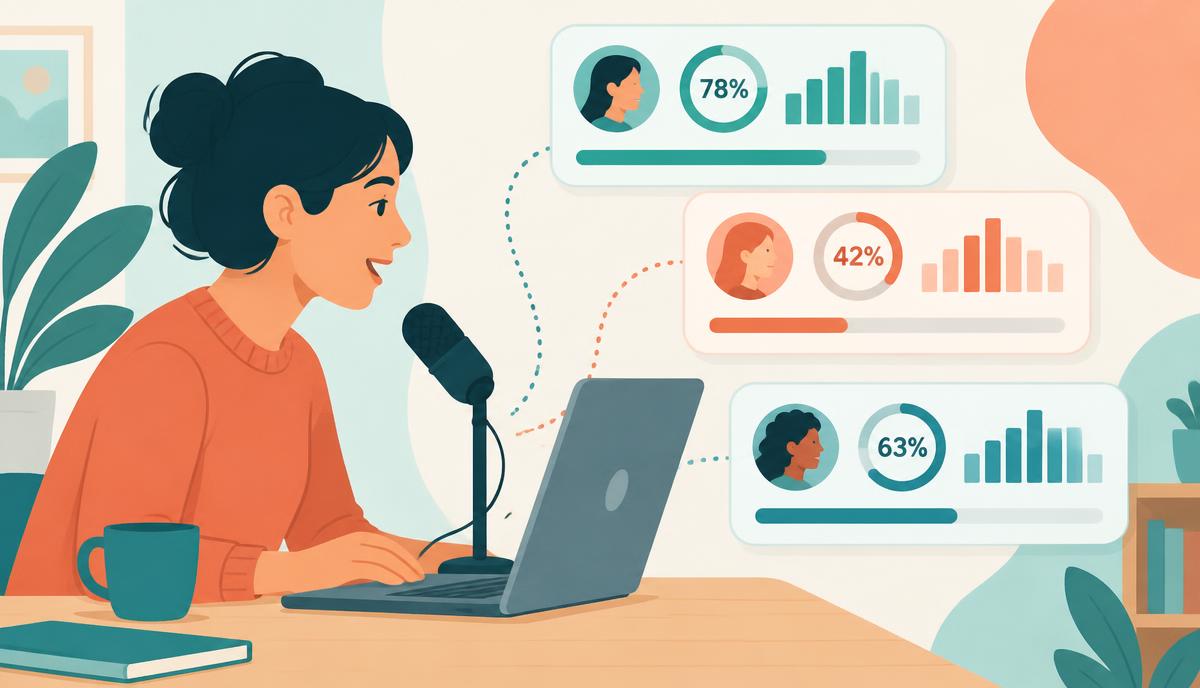
You record yourself on one AI accent detector and it says "Indian English, 72%." A second tool says "British English, 58%." A third, run the next morning, labels you "Neutral / General American." Same voice, same person, three different answers. It is easy to conclude that every detector is broken, or that your accent keeps changing. Neither is usually true.
An AI accent detector is a pattern-matching system. Its answer depends on what it hears, what it was trained on, and which labels it is allowed to choose from. Once you understand those three inputs, the mixed results start to make sense, and you can run a test that gives you something useful instead of a confusing score.
How an AI Accent Detector Actually Works
Most accent identification tools follow the same basic pipeline, even if their interfaces look very different. Knowing the steps helps you see where variation creeps in.
- Audio capture: your microphone records a few seconds to a few minutes of speech, along with any room echo, fan hum or keyboard noise.
- Feature extraction: the system converts sound into measurable features such as vowel quality, rhythm, pitch movement and how consonants like t, r and th are produced.
- Comparison with training data: a model compares those features with recordings it learned from, which were tagged with accent labels.
- Label output: the model returns the closest label, often with a confidence percentage or a ranked list.
Every step has choices built in. A tool trained mostly on news broadcasts hears the world differently from one trained on call center audio. A tool with eight labels must squeeze your voice into one of eight boxes, while a tool with forty labels can be more specific but also more uncertain.
Seven Reasons Your Accent Test Results Change
The table below lists the most common causes of inconsistent accent detector accuracy, what each one changes, and a simple fix you can apply before your next test.
| Cause | What it changes | Fix |
|---|---|---|
| Microphone and background noise | Masks consonants and high-frequency detail, so the model guesses from rhythm alone | Use the same headset in a quiet room every time |
| Recording length | Ten seconds gives too few vowels and stress patterns to compare | Record at least 45–60 seconds of speech |
| Reading vs free speech | Reading aloud often sounds more "textbook"; free speech shows your natural habits | Test both and compare, rather than mixing them |
| Mood, speed and fatigue | Fast or tired speech reduces vowels and blurs word endings | Test at a similar time of day at a calm pace |
| Different label sets | One tool may only offer "American" and "British," another splits India, Nigeria or the Philippines | Compare tools only on labels they both include |
| Training data gaps | Accents with little training audio get pushed toward a better-represented label | Treat rare-accent results as rough hints, not verdicts |
| Confidence thresholds | Some tools show a label even at 40% certainty; others say "unclear" | Always read the percentage, not just the label |
Notice that only one row, mood and speed, is about you changing. The rest are about the recording or the tool. That is why the same speaker can collect different labels in a single afternoon.
Same Voice, Different Labels: A Worked Example
Imagine Priya, a software engineer who grew up speaking Tamil and English in Chennai, studied with British-style textbooks, and now works with a US team. Her English mixes several influences: syllable-timed rhythm, a crisp unaspirated t, some non-rhotic vowels, and American vocabulary picked up from daily stand-ups.
Tool A: a short, broad classifier
She reads one sentence for ten seconds. The tool only has five labels and was trained heavily on broadcast audio. Her non-rhotic vowels stand out most, so it returns "British English, 58%." The low confidence is the real message: the tool was not sure.
Tool B: a longer, region-aware model
She speaks freely for a minute about her weekend. This model includes South Asian labels and hears her rhythm and t sound clearly. It returns "Indian English, 72%" with "British English" second.
Tool C: a noisy morning test
She tests on a laptop microphone in a café. Noise hides the consonant detail, and the tool falls back on its default category: "General American." This result says more about the café than about Priya.
None of the three tools lied. Each answered a different question with different evidence. Tool B is the most informative because it had the longest sample and the most relevant labels.
How to Get a More Consistent Result
If you want an accent test result you can compare over time, control the variables you can control. This routine takes about fifteen minutes.
- Fix your setup: same headset, same quiet room, microphone two finger-widths from your mouth.
- Prepare two samples: a 45-second reading passage and a 60-second free answer, such as "Describe your job to a new colleague."
- Warm up for two minutes: talk normally first so your first recorded words are not stiff.
- Run each sample through the same tool twice: if the two results disagree, your sample is too short or too noisy.
- Write down the top three labels and their percentages, not just the winner.
- Repeat monthly under the same conditions if you are tracking change.
If you want a structured self-test to pair with a detector, our voice test and result guide for finding your English accent walks through a reading passage, word pairs and a feature table you can score yourself.
How to Read an Accent Detector Result
A result is a probability, not an identity. Read it in three layers.
- The confidence percentage: above roughly 75% means the features matched one label clearly; below 50% means the tool is choosing between several close options.
- The ranked list: if the top two labels are within ten points, you likely have a blended accent, which is very common for multilingual speakers.
- The missing labels: if your first language region is not on the list, the result can only point to the nearest available option.
An accent detector tells you which recordings in its training set you sound most like. It does not tell you whether you are clear, correct or professional.
That distinction matters. Being labeled "Indian English" or "Filipino English" is not a problem to fix. Intelligibility, meaning whether listeners understand your words the first time, is a separate question that a classifier does not measure.
Detector vs Human Coach vs Self-Test
Each method answers a slightly different question. Use them together rather than treating one as the final word.
| Method | Best at | Limits |
|---|---|---|
| AI accent detector | Fast, repeatable labeling; tracking change under fixed conditions | Sensitive to audio quality; limited label sets; no explanation of why |
| Human accent coach | Hearing specific sounds, explaining causes, giving targeted drills and feedback on intelligibility | Costs more; results depend on the coach's own background |
| Self-test with recordings | Free, private, builds your own listening skills | Hard to hear yourself objectively at first |
A good human coach still has a clear advantage: they can tell you that your result shifted because you dropped final consonants when nervous, and then give you a drill for it. No classifier score gives you that explanation. If specific sounds are the issue, start with the five accent test words that reveal how you speak and record them before and after practice.
Where Utell AI Fits
Utell AI includes Accent Oracle, an accent analysis feature, alongside real-time accent conversion, noise cancellation and live translation for calls. Accent Oracle follows the same rules described above: a clean, longer sample gives a more stable result, and the output should be read as a guide rather than a verdict.
The real-time conversion side is aimed at a different moment. When you are on a live call and need listeners to catch every word, it adjusts how your voice sounds as you speak. It does not teach pronunciation, and it does not replace practice or a coach. It also cannot remove every background sound, so the setup advice above still applies. If you want to test it on a real call, you can try Utell AI.
For more practice ideas, browse the Pronunciation Skills articles.
FAQ
Can an AI accent detector be 100% accurate?
No. Accents are continuous, not fixed boxes, and many people blend two or three influences. A detector can be very consistent under fixed conditions, but its label is always an estimate based on its training audio. High confidence on a clean recording is useful; treating any single result as certain is not.
Why does my accent change when I am nervous or tired?
Stress and fatigue speed up speech and reduce effort on vowels and word endings. Many speakers also slip back toward first-language rhythm under pressure. A detector picks up those shifts, so a test taken after a long shift may differ from one taken on a calm morning, even with the same microphone.
Should I worry if the result says I have a strong accent?
Not by itself. An accent label describes where your sounds come from, not whether people understand you. Many speakers with clear regional accents are easy to follow. Focus on intelligibility: ask colleagues where they lose track, and work on those specific words or patterns instead of chasing a different label.
How often should I retest to track progress?
Once a month is usually enough. Accent features change slowly, and weekly tests mostly capture noise from mood and recording conditions. Keep the same headset, room, reading passage and free-speech prompt each time, and compare the top three labels with their percentages rather than only the winning label.

Sound clearer on your next call
Utell AI converts your accent and cleans up background noise in real time.


