





Home›Blog›Accent Changer for Freelancers: Fix Client-Call Clarity
WorkplaceAccent Changer for Freelancers: Fix Client-Call Clarity
Contents
- 1.Where accent friction actually costs freelancers money
- 2.Diagnose your own bottleneck before you buy anything
- 3.Four ways freelancers solve it, compared
- 4.Why real-time conversion suits the freelance workflow specifically
- 5.A two-week trial plan that produces evidence, not vibes
- 6.Habits that multiply whatever tool you pick
- 7.FAQ

Freelancing removes the office but not the audio. Almost every paid hour now runs through a discovery call, a client stand-up, a screen-share walkthrough, or a recorded loom. When a client has to replay a sentence twice, the cost is not embarrassment: it is scope confusion, longer calls, and slower approvals. This guide looks at where accent friction actually hurts independent workers, compares the four realistic fixes side by side, and shows where a real-time accent converter such as Utell AI fits and where it does not.
Where accent friction actually costs freelancers money
The problem is rarely "the client cannot understand me at all." It is a slow tax spread across the parts of freelance work that are unbilled.
- Discovery calls. The first 10 minutes decide whether a prospect sees you as a peer or a risk. Repeated clarification requests eat the time you needed to ask about budget and scope.
- Requirement gathering. A misheard number, deadline, or file name becomes a revision round you do for free.
- Async video. Recorded walkthroughs are watched at 1.5x speed by people multitasking. Anything unclear gets skipped, not rewound.
- Rate conversations. Negotiation is the moment you least want to sound hesitant, and repeating yourself reads as hesitation.
Two research findings explain why this happens even when your grammar and vocabulary are strong. Work on processing fluency shows listeners rate statements spoken in an unfamiliar accent as less truthful, because the message is harder to process, not because of any judgment about the speaker. A later study in Frontiers in Computer Science found listeners assigned different credibility ratings to identical content read in different accents. For a salaried employee that bias is diluted across months of visible work. For a freelancer judged on one 30-minute call, it lands all at once.
The freelance-specific problem is sample size. An employee gets a hundred chances to be understood. A freelancer often gets one call before the client picks someone else.
Diagnose your own bottleneck before you buy anything
Different symptoms need different tools, and buying the wrong one wastes months. Record three recent client calls with consent and count these four events:
- Clarification requests ("sorry, say that again?") per 10 minutes.
- Noise interruptions — the client reacting to your keyboard, street, cafe, or fan rather than your speech.
- Self-corrections where you restarted a sentence because you lost the word.
- Speed spikes where you rushed a sentence and it collapsed.
If most hits land on items 1 and 4, clarity of delivery is your bottleneck. If they land on item 2, you have a microphone and environment problem, not an accent problem. If item 3 dominates, the issue is fluency and confidence, and a converter will not fix it — practical drills such as those in our guide on speaking English without freezing up will serve you better.
Four ways freelancers solve it, compared
Independent workers realistically choose among four options. They solve different halves of the problem, and the honest comparison matters more than a pitch.
| Option | What it changes | Time to benefit | Works on live calls | Main limitation |
|---|---|---|---|---|
| Accent coaching / classes | Your own articulation habits, permanently | 3–12 months | Only after you have practiced | Slow, ongoing cost, needs weekly discipline |
| Noise suppression (e.g. Krisp) | Background noise and echo around your voice | Immediate | Yes | Does not touch pronunciation or intelligibility of the words themselves |
| Captions / transcripts | Gives the listener a text fallback | Immediate | Partly | Splits client attention; useless on audio-only calls; errors on technical terms |
| Real-time accent conversion (Utell AI) | How your live speech is rendered to the listener | Immediate | Yes | Needs a stable machine and headset; does not teach you the language |
The comparison people ask about most is Utell AI versus Krisp, so it deserves a fair framing rather than a winner declaration.
Where Krisp is genuinely the better buy
Krisp is a mature noise-cancellation product with a long track record, wide app coverage, and features freelancers value beyond audio — meeting transcription and call notes among them. If you work from a shared flat, a co-working space, or a cafe, and the complaint you hear is "there is a lot going on behind you," Krisp solves your actual problem. It is also the safer pick if your clients are already used to your voice and only the environment is letting you down.
Where an accent converter does something Krisp cannot
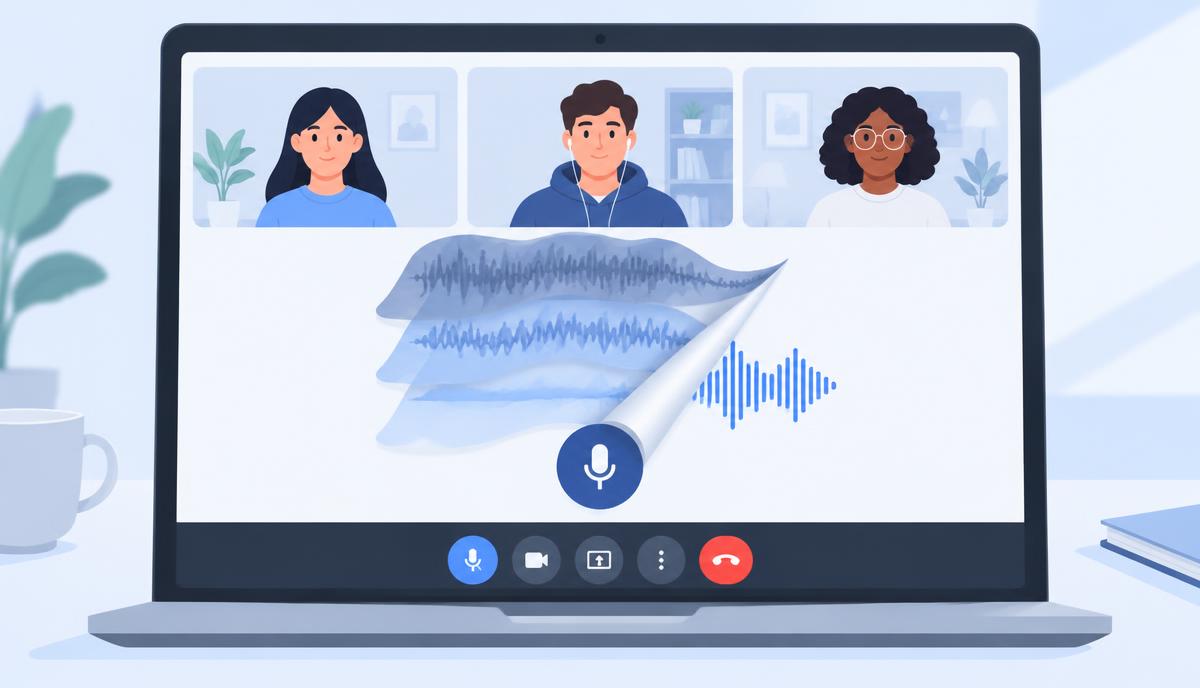
Noise suppression cleans the space around your words; it leaves the words themselves untouched. If the transcript of your call is accurate but the client still asks you to repeat things, no amount of noise removal helps. Utell AI works on the speech signal itself, converting accented English into a more neutral rendering in real time while the call is running, and layering noise cancellation and sound-quality enhancement on top. For a freelancer, that means the fix applies on the first call with a new client — not after a quarter of lessons. Our longer Krisp review and alternatives breakdown goes deeper into the feature-by-feature detail.
Why real-time conversion suits the freelance workflow specifically
Three constraints define independent work, and each one favors a tool that works instantly on live audio.
You cannot schedule your improvement curve
Employees can tell a manager they are working on communication and get six months of patience. A prospect who books you on Tuesday hears you on Wednesday. Coaching remains the only route to permanent change, and it is worth starting — see our comparison of online accent reduction classes — but it cannot cover the call that pays next month's invoice.
Your platform mix is unpredictable
One client uses Zoom, another insists on Teams, a third sends a Google Meet link, and an agency wants a Discord huddle. Utell AI processes your microphone input before it reaches the app, so the same setup carries across meeting tools without per-platform configuration.
You are also the recording studio
Freelancers record loom walkthroughs, voice notes, and proposal videos with no producer to fix the audio. Running conversion and noise cancellation on the input means the recorded asset is clean the first time, which removes an editing pass you were doing unpaid.
Two boundaries are worth stating plainly. Utell AI is a real-time speech-processing tool, not a language course and not an entertainment voice changer: it will not build your vocabulary, and it cannot rescue a sentence whose grammar collapsed. It also cannot remove every environmental sound in every room — a decent headset still matters. Product capabilities described here are accurate as of August 2026.
A two-week trial plan that produces evidence, not vibes
Do not judge any of these tools by how you feel after one call. Run a simple split test instead.
- Week 1, baseline. Keep your current setup. After each client call, log call length, number of clarification requests, and whether the next step was agreed on that call.
- Week 2, converter on. Same log, same call types. Keep the microphone, room, and time of day constant so the only variable changes.
- Read three numbers. Average clarification requests per call, average call length for the same meeting type, and same-call next-step rate.
- Sanity-check with one client. Ask a friendly repeat client whether the audio sounded natural. If anyone describes it as robotic, adjust the settings before rolling it out to prospects.
If clarification requests drop but call length does not, you were losing time to something else — usually an unstructured agenda. That is a useful finding too.
Habits that multiply whatever tool you pick
- Front-load the numbers. Say prices, dates, and quantities slowly and repeat them in the chat box. Digits are the most misheard items on any call.
- Cut your speaking rate by about 10% in the first two minutes, while the client's ear is still calibrating to you.
- Use a wired headset with a boom mic. Laptop microphones pick up the whole room; no software fully undoes that.
- Send a written recap within an hour. It converts any residual ambiguity into a record both sides can correct.
- Practice your three standard answers — what you do, how you price, what your timeline looks like — until they are automatic. See our guide on breaking through accent barriers at work for more structured drills.
If clarity on client calls is the thing standing between you and higher-value projects, the fastest experiment is the one you can run this week.
Try Utell AI free on your next client call
FAQ
Will clients notice I am using an accent converter?
Listeners typically hear clearer, more even speech rather than a different person, because the tool adjusts pronunciation rather than replacing your voice with a synthetic one. The safest check is to record a short sample and ask a repeat client for a reaction before you use it in a pitch. If anything sounds unnatural on your machine, lower the processing intensity and retest.
Is it dishonest to use one on a client call?
It is the same category of tool as noise cancellation, background blur, or a better microphone: it improves how your existing words reach the listener. It becomes a problem only if you use it to imply you are a different person or a native speaker of a language you cannot actually work in. Describe your language ability accurately in your profile and there is nothing to disclose.
Do I still need accent coaching if I use a converter?
They solve different timeframes. A converter helps on the call happening tomorrow; coaching changes how you speak when no software is running, including in-person meetings and conference talks. Freelancers with steady client-facing work usually get the best return from running the converter now and taking lessons in parallel over the following months.
Can I use it alongside a noise-suppression app like Krisp?
Stacking two tools that both capture and reprocess your microphone can cause latency or dropouts, since each one inserts itself as a virtual input device. Pick one as the primary audio processor and disable the other, then compare recordings from both setups. Utell AI already includes noise cancellation and sound-quality enhancement, so running a second suppressor is usually redundant.

Sound clearer on your next call
Utell AI converts your accent and cleans up background noise in real time.


