




Home›Blog›How Many Americans Speak With a Spanish Accent?
Global CommunicationHow Many Americans Speak With a Spanish Accent?
Contents
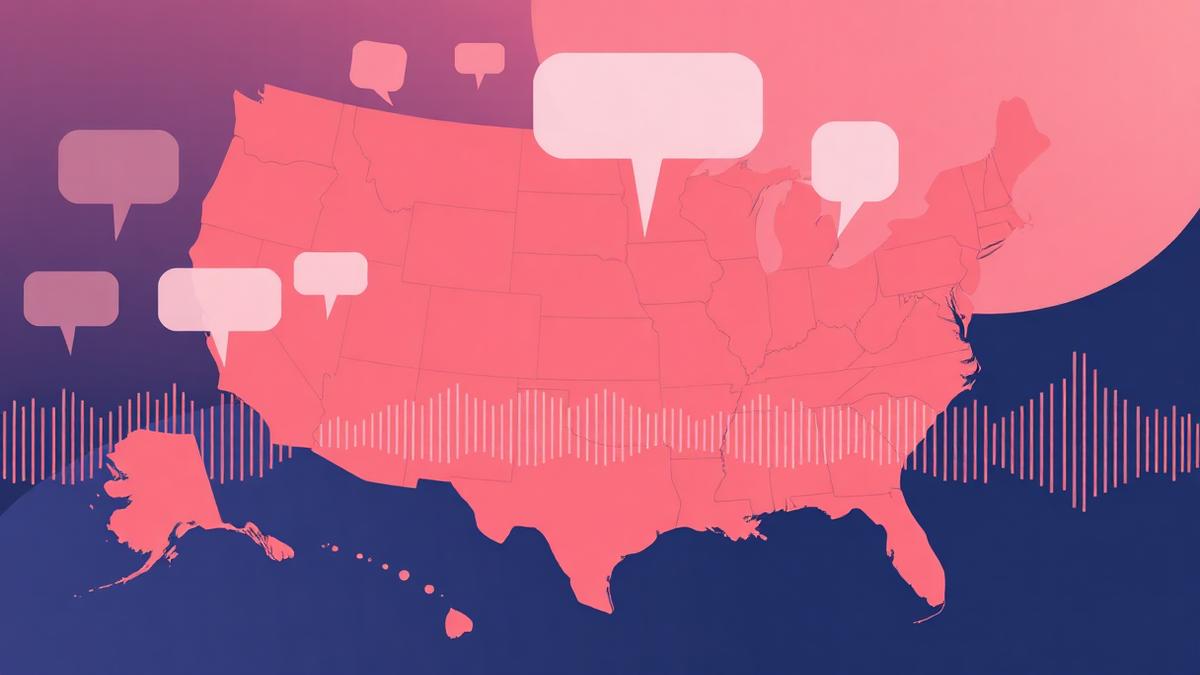
If you have ever wondered how many people speak with a Spanish accent in America, the short answer is: tens of millions, and the number is larger than most people assume. Spanish-influenced English is not a niche way of speaking in the United States. It is one of the country's most widely heard varieties of English, and in several states it is the everyday sound of customer service, healthcare and construction.
This article puts numbers on that population, maps where those speakers live and work, and then looks at what the accent actually changes in daily life — on phone lines, with voice assistants, in clinics and in hiring. All figures below cite their source and the period they describe.
How many people speak with a Spanish accent in America
No agency counts accents directly. What the US Census Bureau measures is language spoken at home and self-rated English ability, and those two figures bracket the answer well enough to be useful.
| Measure | Approximate figure | Source and period |
|---|---|---|
| People who speak Spanish at home (age 5+) | ~42–43 million | US Census Bureau, American Community Survey, recent 1-year estimates |
| Hispanic or Latino population overall | ~65 million (about 19% of the US) | Census Bureau population estimates |
| Spanish speakers who also speak English "very well" | Roughly 6 in 10 | ACS self-reported English ability |
| Hispanic adults who are foreign born | Roughly one third and falling | Pew Research Center analyses of Census data |
| US-born Hispanic adults who speak English proficiently | Around 9 in 10 | Pew Research Center |
Read together, those rows give a working estimate. The pool of people whose English carries audible Spanish influence is somewhere in the range of 25 to 35 million — smaller than the 42 million who speak Spanish at home, because many US-born bilinguals speak English with a regional American accent, and larger than the count of recent arrivals, because accent features persist for decades after fluency is complete.
Two details matter more than the headline number. First, accent and proficiency are independent: a fully fluent speaker with a 30-year career in English can still have a strong accent, and often does. Second, the generational pattern is steep. First-generation speakers usually keep clear Spanish phonology; the second generation typically sounds local with occasional carry-over features; by the third generation, audible influence is usually gone even when Spanish is still understood.
Where they live and what they do
The population is concentrated rather than evenly spread, which is why perceptions of "how common" this accent is differ so much between a recruiter in Miami and one in Vermont.
| State | Share of residents who speak Spanish at home | Rough scale |
|---|---|---|
| California | Around 28% | ~10 million speakers |
| Texas | Around 29% | ~8 million speakers |
| Florida | Around 22% | ~4.5 million speakers |
| New York | Around 15% | ~2.8 million speakers |
| New Mexico | Around 26% | Highest share per capita after Texas |
| Illinois, Arizona, New Jersey | 13–21% | ~1–2 million each |
Figures are approximate ACS shares for the population aged 5 and over. The occupational picture matters just as much, because it decides how often the accent is heard through a microphone rather than face to face.
- Customer support, call centers and BPO — speech is the product, and it travels through a compressed phone codec.
- Healthcare and home care — Hispanic workers are heavily represented in nursing assistance and personal care, where instructions and dosages are spoken.
- Construction — roughly a third of the US construction workforce is Hispanic, per Bureau of Labor Statistics data, much of it coordinated over radio and phone.
- Hospitality, food service and retail — constant short exchanges with strangers who have no time to adjust.
- Education and sales — where perceived authority is tied to how easily listeners process what you say.
Why a Spanish accent sounds different
The differences come from one compact sound system running a much larger one. Spanish has five vowels; General American has roughly fourteen. Spanish is syllable-timed, giving every syllable near-equal length; English is stress-timed and reduces everything unstressed to a schwa.
| Feature | What listeners hear |
|---|---|
| /i/ and /ɪ/ merged | sheep and ship sound alike |
| Single low vowel | cat, cot and cut converge |
| No word-initial s + consonant | school → eschool |
| /b/ and /v/ one phoneme | berry and very |
| Even syllable timing | The sentence is clear, but its stress peaks are flat |
That last row does most of the work. American listeners use stress peaks to find the informative words before they finish parsing a sentence, so flat timing raises effort even when every sound is correct. The full phonetic breakdown, with the training implications, is in our guide to moving from a Spanish accent to an American accent.
What the accent changes in daily life
For most speakers the day-to-day cost is not being misunderstood. It is the repeated small tax of extra repetitions, extra confirmations and occasional misjudgement.
| Situation | What goes wrong | What helps |
|---|---|---|
| Phone and VoIP calls | Compression strips the frequency detail that separates merged vowels; repetition requests cluster in the first 30 seconds | Slower opening, better microphone, spelled-out names |
| Voice assistants and IVR | Published research on speech recognition has repeatedly found higher word error rates for accented and non-native speech than for majority-accent speech | Fixed phrasing, keypad fallback, digit chunking |
| Medical appointments | Numbers, dosages and symptom words carry the load; a merged vowel is not cosmetic here | Confirm-back, written notes, interpreter rights |
| Job interviews | Audit studies have long found callback penalties tied to perceived ethnicity and speech; interviewers also rate harder-to-process speech as less confident | Rehearsed openings, structured answers, clear pacing |
| Housing, schools, government lines | Time-limited calls with staff who cannot slow down | Prepared scripts, written follow-up |
Research on processing fluency is the uncomfortable part of that table. Studies have found that identical statements are rated as less credible when delivered in an accent that takes more effort to process. That is a bias in the listener, not a defect in the speaker — but the speaker absorbs the cost, which is why so many people look for a fix.
Three ideas worth dropping: that clarity requires losing your accent, that speaking faster sounds more fluent, and that drilling isolated sounds transfers to real conversation. None of the three hold up.
What actually helps
| Method | Time to result | Typical cost | Scope |
|---|---|---|---|
| Self-directed drills | Months | Free to low | All situations, needs discipline |
| Accent coach | 3–12 months | High per hour | All situations, permanent |
| Shadowing recordings | Weeks to months | Free | Best single fix for rhythm |
| Microphone and script control | Same day | Cost of a mic | Calls and recordings |
| Noise suppression (e.g. Krisp) | Same day | Low subscription | Removes noise, not accent |
| Real-time accent conversion | Same day | Low subscription | Outgoing online audio only |
Two honest notes. A coach is the only route that changes how you sound everywhere, including in person, and no software substitutes for that. And a dedicated noise tool such as Krisp is better at suppressing a barking dog than any accent tool is — if noise is your actual complaint, buy the noise tool. A broader comparison of the training routes sits in the main ways to sound more American, and the support-desk version of the problem is covered in our piece on accent changers for Amazon customer service work.
Where Utell AI fits — and where it doesn't
Utell AI is a real-time voice layer for calls, meetings and streams. It converts your accent as you speak, cancels background noise, enhances audio clarity and can run live translation, all applied to the outgoing audio of whatever app you already use. As of August 2026 it also includes Accent Oracle, which identifies accent characteristics from a speech sample.
The limits are the honest part. It does not teach English, does not replace pronunciation practice, does not change how you sound across a dinner table, and will not strip every trace of noise from a bad room. What it does is lower the listener's decoding effort on the one channel where the cost concentrates for millions of Spanish-speaking professionals: the headset. Your words, pacing and personality stay yours.
If most of your English reaches other people through a microphone, fix that channel first. Try Utell AI free on one real call and judge it from the other side of the line.
FAQ
How many people in the US speak Spanish at home?
American Community Survey estimates from the US Census Bureau put it at roughly 42 to 43 million people aged five and over, making Spanish by far the most spoken non-English language in the country. Most of them also speak English, and about six in ten report speaking it "very well."
Is that the same as the number of people with a Spanish accent?
No. Many US-born bilinguals speak English with a local regional accent and no Spanish influence at all, while some people who rarely speak Spanish still carry inherited features. A reasonable working estimate for audibly Spanish-influenced English is 25 to 35 million speakers, since no survey measures accent directly.
Which states have the most Spanish speakers?
California and Texas lead by raw numbers, with roughly ten and eight million home Spanish speakers respectively. By share of population, Texas, New Mexico and California sit highest, each around a quarter or more of residents. Florida, New York, Arizona, Illinois and New Jersey follow with large absolute populations.
Does a Spanish accent affect job prospects?
It can, though the mechanism is listener bias rather than communication failure. Audit research has documented callback penalties linked to perceived ethnicity and speech, and processing-fluency studies show harder-to-parse speech is rated as less credible. Preparation, pacing and clearer audio reduce the effect; they do not remove the underlying bias.
Can voice assistants understand Spanish-accented English?
Usually, but less reliably. Multiple published evaluations of commercial speech recognition report higher word error rates for accented and non-native speakers than for majority-accent speakers. Practical workarounds include using consistent phrasing, chunking digits, and falling back to keypad entry on automated phone menus.

Sound clearer on your next call
Utell AI converts your accent and cleans up background noise in real time.


