





Home›Blog›Which US Industries Employ the Most Filipinos?
WorkplaceWhich US Industries Employ the Most Filipinos?
Contents
- 1.Where Filipino workers actually concentrate in the US
- 2.Nursing and healthcare: the defining industry
- 3.Hospitality, aviation and the military-adjacent sectors
- 4.The BPO layer: serving US customers from the Philippines
- 5.The licensing-exposure matrix
- 6.What people misread about Filipino accents at work
- 7.What workers in high-exposure roles try today
- 8.Where Utell AI fits — and where it doesn't
- 9.FAQ
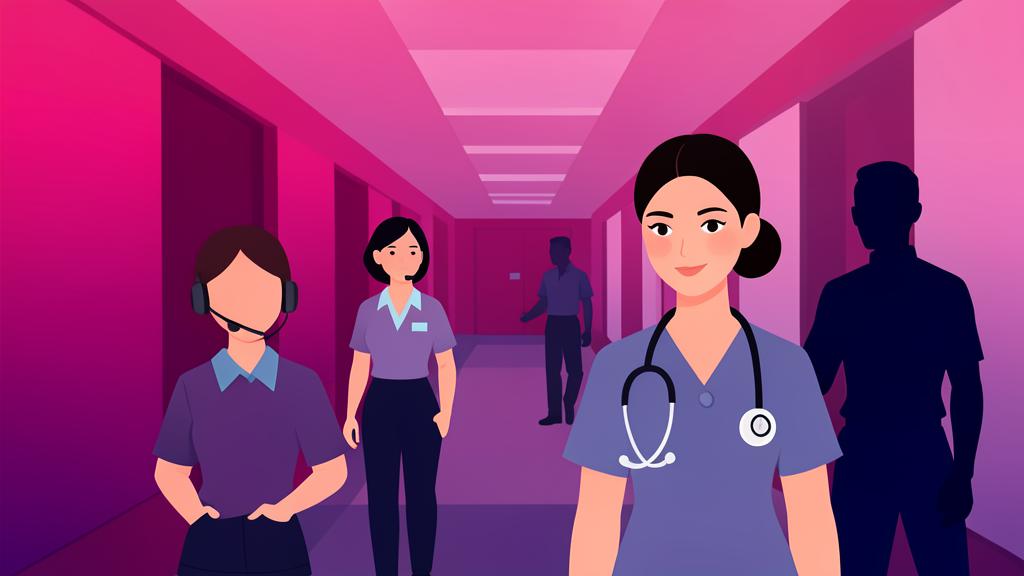
Ask where Filipino workers concentrate in the American economy and most people guess call centers. That answer belongs to Manila, not to the United States. Inside the US, Filipino workers cluster in a different and surprising pattern: healthcare dominates so completely that roughly one in five Filipino American workers touches the sector, and registered nursing alone has become the single most identified occupation of the entire community.
This article maps where Filipino workers actually work in the US, using census and industry data with as-of dates, then adds the layer most rankings miss: the million-plus workers in the Philippines serving American customers remotely. Finally, it looks at what each industry's voice exposure means for the Filipino accent at work.
Where Filipino workers actually concentrate in the US
As of 2026, about 4.4 to 4.7 million Filipino Americans live in the United States, making them the third-largest Asian American group, per US Census American Community Survey estimates. Their industry distribution looks nothing like the Indian American pattern we covered in our piece on which workplaces employ the most Indians, where software leads. For Filipinos, one sector towers over the rest.
| Industry | Share of Filipino American workers | Notes and representative employers |
|---|---|---|
| Healthcare and social assistance | ~20–25% | Kaiser Permanente, Dignity Health, HCA; nursing dominates |
| Accommodation and food services | ~10–12% | Hotels, cruise lines, casino resorts in Nevada and Hawaii |
| Retail trade | ~10% | Big-box retail, pharmacies, grocery chains |
| Transportation and warehousing | ~6–8% | Airlines, logistics, ports on the West Coast |
| Finance, insurance and accounting | ~5–7% | Accounting is a historically Filipino-staffed profession |
| Public administration and military-adjacent | ~4–6% | Navy veterans' families, federal civilian roles, base services |
These ranges are estimated from ACS industry-by-ancestry tabulations and Pew Research Center profiles, as of August 2026. Exact percentages shift year to year, but the ranking has been stable for two decades: healthcare first, hospitality second, everything else well behind.
Geography amplifies the concentration. California alone holds roughly 40% of Filipino Americans, with Hawaii, Nevada, Washington and Texas rounding out the top states. In Hawaii, Filipinos are one of the largest ethnic groups in the entire labor force, which is why hotels and hospitals in Honolulu recruit through Filipino community networks directly.
Nursing and healthcare: the defining industry
No single occupation defines any American ethnic group the way registered nursing defines Filipino America. About 4% of all registered nurses in the US are Filipino, as of 2024 estimates from the National Council of State Boards of Nursing workforce surveys — roughly 150,000 nurses — and Filipinos consistently make up the largest share of internationally educated nurses in the country, ahead of every other source nation.
The pipeline has structural roots. American colonial administration built the Philippine nursing school system on the US model starting in the early 1900s, and post-1965 immigration law prioritized exactly the credentialed health workers the Philippines was producing. The result is a century-long loop: Philippine nursing curricula still teach to American licensure exams, and US hospitals still recruit in Manila.
The concentration extends beyond nursing into adjacent clinical roles: medical technologists, physical therapists, caregivers and nursing-home staff. During 2020 and 2021, this exposure turned lethal — studies of pandemic mortality found Filipino nurses dying of COVID-19 at rates far above their share of the workforce, a widely cited National Nurses United report put it at roughly a quarter of nurse deaths from 4% of the nurse population, as of September 2020.
Hospitality, aviation and the military-adjacent sectors
The second cluster is face-to-face service. Cruise lines are the extreme case: Filipinos have long been the largest nationality group in global cruise ship crews, with industry estimates as of 2024 placing them at a quarter to a third of all seafaring hotel staff. Major US-based cruise brands recruit tens of thousands of Filipino crew members annually, which means a worker can spend a career serving American guests without ever holding a US work visa.
On land, the pattern repeats in Las Vegas casinos, Hawaiian resorts and West Coast airlines. A third pillar is military-adjacent employment: tens of thousands of Filipinos served in the US Navy under a special recruitment agreement, and their families formed the nucleus of Filipino communities in San Diego, Norfolk and Bremerton, staffing base services, shipyards and federal civilian roles across generations.
The BPO layer: serving US customers from the Philippines
The call-center guess was not wrong — it was just pointed at the wrong side of the Pacific. The Philippine IT and business process management industry employed about 1.7 to 1.8 million people as of 2025, per the IT and Business Process Association of the Philippines, and the United States is its largest client market by far. Voice support for American telecoms, banks, insurers and e-commerce platforms is the industry's original core.
This creates a two-layer picture that pure US census data hides. A Filipino nurse in Los Angeles and a Filipino support agent in Quezon City may both spend their day talking to Americans, but only one of them appears in American workforce statistics. When people say "Filipinos work in call centers," they are describing the second layer — a workforce serving the US economy without living in it.
The BPO layer is also where the voice channel matters most. A nurse can point, show a chart, or hand over paperwork. A phone agent has nothing but audio, which is why our breakdown of the differences between Philippine and American accents spends so much time on the rhythm features that phone codecs strip out.
The licensing-exposure matrix
Industry rankings answer "where." They do not answer "how much does accent matter there." For that, two axes do most of the work: how high the credential barrier is, and how much of the job runs through live voice with strangers.
| Sector | Credential barrier | Voice exposure | What that means for accent pressure |
|---|---|---|---|
| Registered nursing | High (NCLEX licensure) | High, face-to-face | Patient trust and handoff clarity; pressure is real but moderated by context, gestures and shared routines |
| US-facing BPO | Low | Extreme, voice-only | The accent is the product interface; agents get neutral-accent training from day one |
| Accounting and back office | High (CPA track) | Low to moderate | Written work dominates; accent rarely a factor in career progression |
| Cruise and hotel service | Low to moderate | High, face-to-face | Guest-facing scripts reduce free-form speech; multilingual crews normalize accents |
| Logistics and warehousing | Low | Low | Team-internal communication; almost no public voice exposure |
Notice how different this is from the Indian American distribution. Software engineering — the Indian cluster's anchor — is high-density but medium voice exposure, so accent pressure arrives late, in meetings and interviews. The Filipino cluster's anchor industries put workers in front of patients and guests on day one. Same community size, opposite exposure profile.
What people misread about Filipino accents at work
| Misconception | What the data and daily practice actually show |
|---|---|
| "Hospitals are diverse, so accent is not an issue in nursing" | Diversity among staff does not reduce patient-facing decoding effort. Handoff errors track communication clarity, and studies of internationally educated nurses consistently list accent as a top workplace stressor, for the nurse, not the listener |
| "Filipino BPO agents already sound American" | Agents train toward a neutral American target and many get close, but training budgets concentrate on the first ninety days. Sustained call quality still shows up in repeat-request rates and handle-time metrics |
| "The Philippine accent is basically American anyway" | The reference model is American, but the rhythm is syllable-timed and several vowel pairs merge. The differences are small on paper and large on a compressed phone line, as we detail in our feature-by-feature comparison |
| "If communication matters, employers should just screen for accent" | Accent screening in hiring is legally risky under US discrimination law unless tied to a documented job requirement, and it screens out exactly the bilingual workers these industries compete for |
What workers in high-exposure roles try today
Four approaches dominate, and they are complements, not substitutes:
- Accent coaching. The most durable route. A structured program over three to six months measurably improves listener comprehension, and it works in every room, not just online ones. The cost is hundreds to thousands of dollars and the timeline is months, which is why uptake is concentrated among nurses and managers whose careers justify it.
- Shadowing and self-practice. Free and genuinely effective for rhythm and stress placement, the features that carry the most weight for Filipino speakers. The weakness is feedback: without a trained ear, practice plateaus quickly.
- Noise cancellation. Tools like Krisp deserve real credit here: on a noisy hospital floor or a crowded BPO floor, removing background noise genuinely lifts intelligibility, and Krisp's suppression quality is excellent. It does nothing for accent, though — it cleans the channel, not the speech.
- Real-time accent conversion. The newest option, and the only one that works on day one. It adjusts pronunciation features on outgoing audio while the speaker keeps their own words and timing — but it only exists on the online channel.
Where Utell AI fits — and where it doesn't
Utell AI is a real-time voice layer for calls, meetings and streams: it converts your accent as you speak, cancels background noise, enhances clarity, and can run live translation, all on the outgoing audio of whatever app you already use. As of September 2026 it also includes Accent Oracle, which identifies accent characteristics from a short speech sample.
For the BPO agent whose entire job is a phone line, or the travel nurse doing telehealth triage, that channel coverage is the point. For the floor nurse whose hardest conversations happen at a bedside, software cannot reach — that is coaching territory, and we say so plainly. The honest split is the one we laid out in our analysis of AI in voice work: use real-time tools for the calls that pay you this month, use coaching for the career.
If your workday runs through a headset, try Utell AI free and test it on one real call before you decide anything.
FAQ
Which US industry employs the most Filipino workers?
Healthcare and social assistance, by a wide margin. Roughly 20 to 25 percent of Filipino American workers are in the sector as of 2026 estimates from census ancestry data, with registered nursing the single most common occupation. Hospitality and food service rank a distant second, concentrated in Nevada, Hawaii and California.
How many nurses in the US are Filipino?
About 150,000, or roughly 4 percent of all registered nurses, based on National Council of State Boards of Nursing workforce survey estimates as of 2024. Filipinos are also the largest group of internationally educated nurses in the country, a pattern rooted in the American-built Philippine nursing school system and post-1965 immigration policy.
Why do so many Filipinos work in call centers?
The call-center workforce is mostly in the Philippines, not the US. The Philippine IT-BPM industry employed about 1.7 to 1.8 million people as of 2025, serving primarily American clients. American companies chose the Philippines for its English proficiency, American-modeled education system and time-zone coverage, and the industry grew from there.
Does a Filipino accent affect nursing work?
It affects stress more than safety. Surveys of internationally educated nurses consistently rank accent among their top workplace concerns, mostly around patient trust and being asked to repeat themselves. Clinical handoffs follow structured protocols that reduce ambiguity, so the cost concentrates in first impressions with new patients rather than in documentation.
Can software reduce accent friction on work calls?
Yes, on the online channel. Real-time accent conversion adjusts pronunciation features on outgoing audio during calls and meetings, and noise cancellation cleans the channel underneath it. Neither replaces coaching for in-person work, and neither should be used to misrepresent identity — the goal is lower decoding effort for the listener, with your own words and timing intact.

Sound clearer on your next call
Utell AI converts your accent and cleans up background noise in real time.


